
A grave that tells a tale
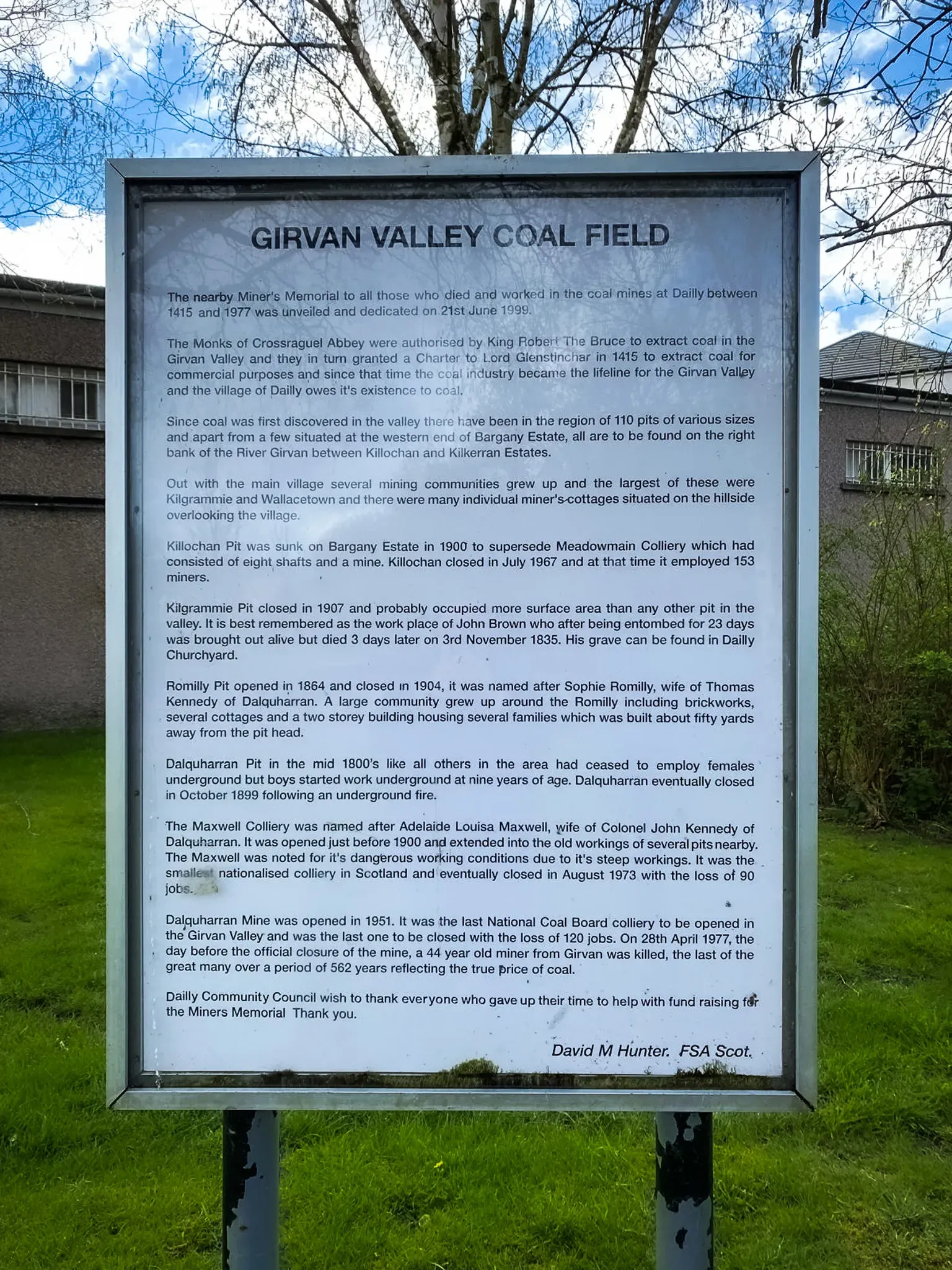
The headstone in the Dailly Church Graveyard, the inscription on which is now barely readable, relates the ordeal of John Brown, an unmarried 66-year-old collier who survived after having been buried underground for 23 days in Kilgrammie Coal Pit.
The fateful morning
The Kilgrammie Coal Pit was in the former Brunston Coal Field on Bargany Estate and then on lease to Joseph Whitfield. On 8th October 1835, at about 5 am, a large portion of the pit collapsed, and the main shaft was badly damaged.
Dangerous days
Over the next two days, a series of falls made it dangerous to enter the workings.
Desperate rescue attempts
Brown trapped alone
When the roof collapsed Brown was the only miner who was not able to escape and on learning that he was trapped, Mr Whitfield the lessee of the pit and four of his colliers attempted to reach Brown by way of a Day Level and in their attempt two of the colliers were almost caught in a further roof fall and the search was abandoned for two days.
Blocked passages
On their return, it was discovered that all the underground roads were completely blocked, and a path had to be cleared through a solid wall of debris; only one man at a time could work at the face.
Two weeks of dangerous digging
The search for Brown continued by day and night for two weeks, with the added danger of gas seeping into where the men were working, and as Mr Whitfield and several others thought that Brown must by now be dead, the official search was called off.
Unofficial heroes continue
The miners were then set to work repairing the damaged main shaft, which had closed when the workings collapsed, but several others continued in their own time to try and reach Brown, and Mr Whitfield encouraged them by offering a reward if and when Brown was found.
Breakthrough at last
First contact
On 30th October, between one and two o’clock in the morning, William Ross and his son broke through into a small opening, but due to exhaustion and bad air, they had to retire. John Scobie and William Sime then attempted to enter the opening, but they too were driven back by gas.
The final push
At about 5 am, they again returned and found that the air was still bad, and with the aid of flat boards, they moved forward, wafting the boards in front of them to disperse the gas.
Finding Brown alive
Once into the opening Brown was found to be alive but very weak. His rescuers laid him on one of the boards that had been used to disperse the gas, and they pushed and pulled him through the low, narrow passage that had been cleared over the past three weeks, and after about three hours, they reached a more stable part of the workings.
The journey to the surface
A careful extraction
By this time, Mr Whitfield had arrived, and it was decided not to remove Brown by the Day Level, which was very unstable, but by another route to an airshaft 250 yards from the main shaft, where a hand windlass was set up. Mr Whitfield sat in a loop of the rope sling of the windlass with Brown lying across his knees, and they were wound up to the surface.
Brief recovery and death
On arrival at the surface, Brown was examined by a doctor and by 9 am, he was safely in bed at his lodgings at Kilgrammie row, and this was where he died three days later on the evening of 3rd November.
After his death, a post-mortem was carried out by two surgeons and two doctors, who found that no improper treatment after his rescue contributed to Brown’s death.
The story lives on
Television recognition
On 23rd February 1964, Associated Television transmitted a film entitled ‘The Devil and John Brown’ which portrayed John Brown’s ordeals during the time he was trapped underground, and in March the following year, the film was selected as the best television play of 1964.
From screen to stage
Thea Musgrave, who composed the background music for ‘The Devil and John Brown’, was so impressed by the incident that she composed an opera about it. The libretto was written by Maurice Lindsay, and the opera entitled ‘The Decision’ received its first two performances in Sadler's Wells Theatre in November 1967.
© David M Hunter FSA Scot., 2001 [Partially edited for the web.]